A great video does more than show images on a screen. It captures attention, creates emotion, communicates a message, and keeps viewers engaged from beginning to end. Behind every compelling video is an editor who understands how to combine footage, sound, transitions, graphics, timing, and storytelling into a polished final production.
With video becoming one of the most powerful forms of digital communication, editing has evolved into an important creative and technical skill. From films and advertisements to YouTube videos, social media reels, corporate presentations, documentaries, and OTT content, professional editing plays a role in almost every type of modern visual media.
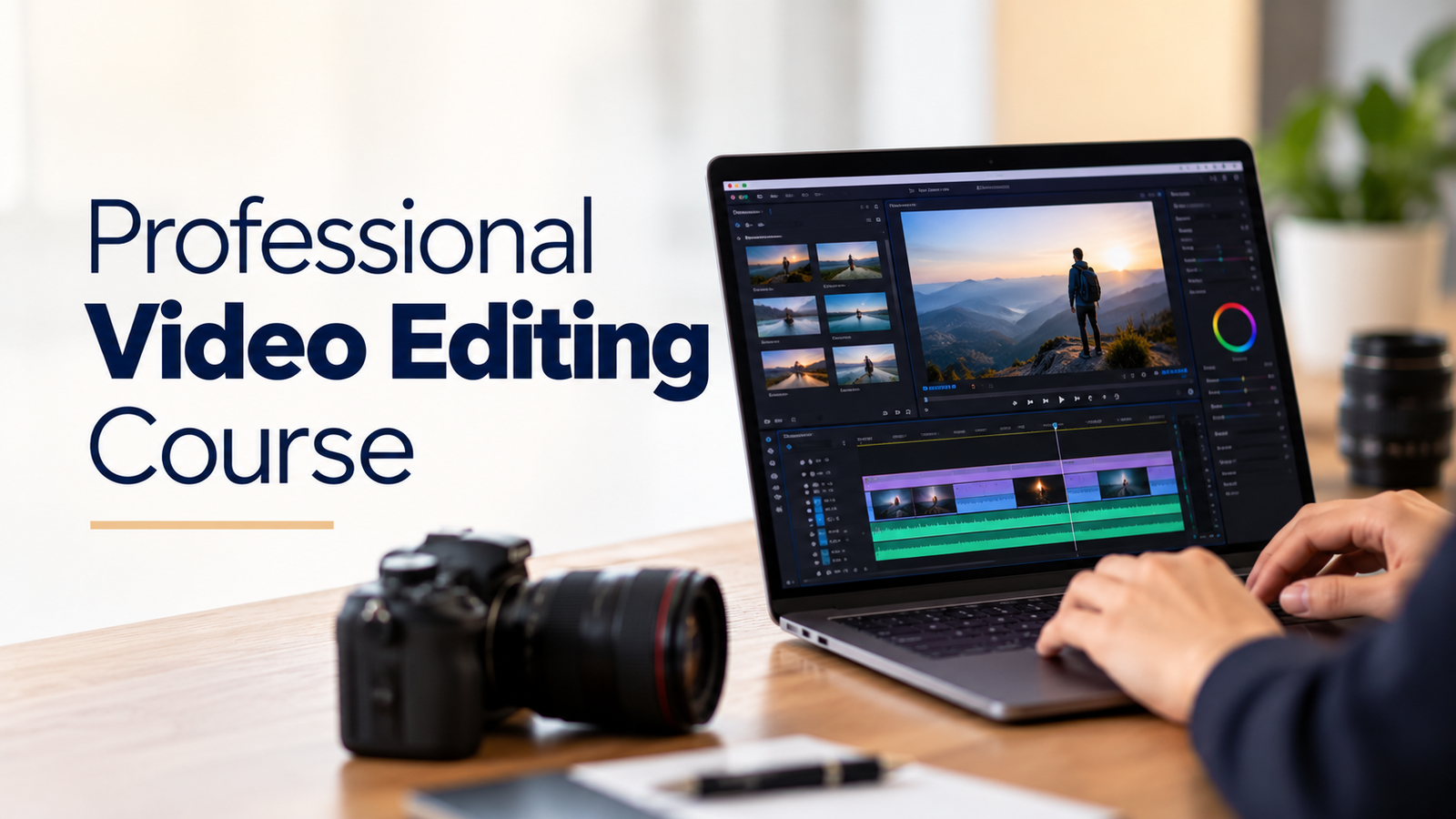
A Professional Video Editing Course can help aspiring editors develop the skills required to transform raw footage into engaging visual stories. At Digiquest Academy, students can explore the creative and technical aspects of editing through structured learning, practical assignments, and project-based experience.
Why Video Editing Has Become a Valuable Creative Skill
Think about the videos you watch every day. A short social media reel, a cinematic film, a product advertisement, a wedding video, or an educational tutorial may look completely different, but they all depend on effective editing.
Editors decide:
- Which shots should appear first
- How long each shot should remain on screen
- Where cuts should happen
- How music should support the visuals
- How transitions should be used
- How colors should look
- Where graphics and text should appear
- How the story should build toward its conclusion
This makes video editing both a technical discipline and a form of storytelling.
A Professional Video Editing Course gives learners the opportunity to understand these decisions rather than simply learning how to cut and join clips.
Professional Video Editing Course: What Will You Actually Learn?
Learning video editing involves much more than knowing where the editing tools are located. Professional editors need to understand footage, storytelling, pacing, sound, visual design, and post-production workflows.
A comprehensive Professional Video Editing Course can introduce learners to areas such as:
Video Editing Fundamentals
Students can begin by understanding timelines, clips, sequences, resolutions, frame rates, formats, and basic editing terminology.
Cutting and Sequencing
The arrangement of shots determines how viewers experience a story. Learners can practice selecting the right footage, making precise cuts, arranging scenes, and creating smooth sequences.
Transitions
Transitions can connect different scenes and create visual continuity. Students can learn when to use simple cuts, fades, dissolves, and other transition techniques without making the video feel unnecessarily complicated.
Audio Editing
Sound can completely change the impact of a video. A Professional Video Editing Course can help students understand dialogue, background music, sound effects, audio levels, synchronization, and basic sound cleanup.
Color Correction and Grading
Color can influence mood, atmosphere, and visual consistency. Students can learn the difference between correcting footage and creatively grading it to achieve a particular look.
Titles and Graphics
Modern videos often require titles, captions, lower thirds, logos, animated text, and other visual elements. Editors need to know how to integrate these elements without distracting viewers.
Exporting and Delivery
The final stage of editing involves preparing a video for its intended platform. Students can learn about formats, resolutions, compression, and export settings for different types of content.
Learn Video Editing Through Storytelling
Imagine receiving two hours of raw footage from a client. The footage may contain excellent moments, but there is no finished story.
This is where an editor’s creative thinking becomes important.
The editor needs to identify the strongest moments, remove unnecessary material, establish an appropriate sequence, synchronize audio, add supporting visuals, and create a rhythm that keeps the audience interested.
This storytelling mindset is a key part of a Professional Video Editing Course.
Students can learn to ask questions such as:
What is the purpose of this video?
Who is the audience?
What should viewers feel?
Which shot communicates the message most effectively?
Where should the pace change?
How can sound improve the scene?
These questions help transform editing from a technical task into a creative process.
Professional Video Editing Course for Beginners and Aspiring Editors
You do not need to be an experienced filmmaker to start learning video editing.
Beginners can start with fundamental concepts and gradually move toward more complex editing projects. A structured Professional Video Editing Course can provide a clear learning pathway so students do not have to figure out every technique independently.
The learning process can progress from simple exercises to complete projects.
For example:
Raw footage → basic cuts → organized timeline → audio → transitions → graphics → color → final export
This practical progression helps learners understand how the different stages of post-production work together.
What Software Skills Are Important for Video Editors?
Professional video editors rely on specialized software to organize footage, create sequences, enhance audio, add effects, and export finished videos.
Depending on the curriculum, students may receive training in industry-relevant editing and post-production software.
However, software knowledge alone does not make someone a good editor.
A skilled editor understands:
- Story structure
- Pacing
- Continuity
- Shot selection
- Visual rhythm
- Audio
- Color
- Composition
- Audience attention
A Professional Video Editing Course should therefore combine software training with creative problem-solving and practical production experience.
Create Different Types of Video Projects
One of the best ways to develop editing ability is to work with different types of footage.
Students can experiment with projects such as:
Social Media Videos
Short-form content requires strong pacing and immediate audience engagement.
YouTube Videos
Longer content requires structure, timing, visual variety, and effective use of supporting graphics.
Promotional Videos
Advertising content needs to communicate a product or service clearly while maintaining visual appeal.
Corporate Videos
Corporate editing often focuses on professionalism, clarity, branding, interviews, presentations, and structured storytelling.
Event Videos
Events contain large amounts of footage. Editors need to select memorable moments and build an engaging narrative.
Short Films
Short films allow learners to practice storytelling, continuity, dialogue editing, music, pacing, and cinematic techniques.
Working on different formats through a Professional Video Editing Course can help students discover the areas of editing they enjoy most.
Professional Video Editing Course and the Importance of Hands-On Practice
You can watch hundreds of editing tutorials, but practical experience remains essential.
Editing skills improve when you actually work with footage, make mistakes, receive feedback, and try again.
Project-based training allows students to experience common editing challenges such as:
- Poorly organized footage
- Uneven audio
- Unwanted background noise
- Continuity problems
- Incorrect framing
- Inconsistent color
- Excessive transitions
- Slow pacing
- Weak storytelling
Solving these problems can help learners develop confidence and technical judgment.
At Digiquest Academy, practical learning can help students move from understanding editing concepts to applying them in creative projects.
Build a Portfolio That Shows Your Editing Ability
For aspiring editors, a portfolio can be more valuable than simply describing what they have learned.
A strong video editing portfolio can demonstrate your ability to work with different styles and formats.
Students completing a Professional Video Editing Course can work toward creating portfolio projects such as:
- Promotional videos
- Social media reels
- YouTube edits
- Short films
- Corporate videos
- Event highlights
- Product videos
- Interview edits
- Cinematic montages
- Before-and-after editing demonstrations
Your portfolio should show not only technical skills but also your ability to make creative decisions.
Career Opportunities After a Professional Video Editing Course
Video editing skills can be applied across a wide range of industries. As organizations increasingly depend on digital video, editors can explore different professional environments.
Potential career roles include:
Video Editor: Edits raw footage into finished video content.
Film Editor: Works on narrative film projects and focuses on storytelling, continuity, pacing, and structure.
Content Editor: Creates and edits videos for online platforms and digital audiences.
Social Media Video Editor: Produces short-form videos, reels, advertisements, and other social content.
Corporate Video Editor: Works on presentations, interviews, promotional videos, training content, and internal communications.
YouTube Video Editor: Helps creators transform recorded footage into engaging online content.
Post-Production Artist: Supports different stages of the post-production process.
Freelance Video Editor: Works independently with multiple clients and projects.
A Professional Video Editing Course can provide the foundational knowledge needed to explore these career directions.
Why Choose Digiquest Academy?
Selecting the right institute can make the learning journey more structured and productive. Students should consider practical training, curriculum quality, software exposure, instructor guidance, projects, and portfolio development when comparing courses.
Digiquest Academy focuses on creative and digital skill development. Its approach to a Professional Video Editing Course can help learners understand editing concepts while gaining practical experience with real-world-style projects.
The combination of technical training and creative practice can help students develop the confidence to experiment with different editing styles and formats.
For someone serious about exploring video editing as a career or professional skill, structured training can provide a useful starting point.
Skills That Can Make You a Better Video Editor
Technical knowledge is only one part of becoming a successful editor. Strong editors also develop professional habits and creative abilities.
Attention to Detail
Small timing issues, audio inconsistencies, or continuity errors can affect the quality of the final video.
Creativity
Editors often need to find new ways to communicate ideas and make ordinary footage more engaging.
Patience
Post-production can involve reviewing footage repeatedly and making many small adjustments.
Communication
Editors often work with directors, clients, content creators, marketers, and other creative professionals.
Time Management
Meeting deadlines is important when working on commercial, social media, corporate, or entertainment projects.
Adaptability
Different projects require different editing styles, formats, and workflows.
A Professional Video Editing Course can help learners develop these skills alongside technical knowledge.
Is Video Editing Only for the Film Industry?
No. Video editing has applications far beyond movies.
Today, organizations and individuals use video for:
- Digital marketing
- Social media
- Education
- E-commerce
- Corporate communication
- Advertising
- Personal branding
- Events
- Online courses
- News and media
- Entertainment
- Influencer content
This diversity means video editing skills can be useful even if you have no plans to work in traditional filmmaking.
Professional Video Editing Course: Turn Raw Footage into Impactful Content
The difference between raw footage and a finished video is often the editor’s creative judgment.
A good editor knows when to cut, when to hold a shot, when to introduce music, when to use silence, and when to let the visuals communicate without additional effects.
Learning these decisions takes practice.
A Professional Video Editing Course can provide the foundation for developing these abilities while giving learners opportunities to work on practical projects.
At Digiquest Academy, aspiring editors can begin developing their understanding of post-production while exploring the creative possibilities of digital video.
Start Building Your Video Editing Skills
The demand for engaging video content continues to create opportunities for people with strong editing and storytelling abilities. Whether your goal is to work with production companies, digital agencies, brands, content creators, or freelance clients, video editing can become a valuable professional skill.
A Professional Video Editing Course can help you start with the fundamentals, understand professional workflows, practice editing techniques, and build projects that demonstrate your abilities.
You do not need to create a blockbuster on your first attempt. Start with a short sequence. Learn how to make the cuts cleaner. Improve the audio. Experiment with pacing. Try a different color treatment. Then create another project.
With every edit, your understanding grows.
Learn the tools. Understand the story. Practice the craft. Build your career with Digiquest Academy.
Frequently Asked Questions About Professional Video Editing Course
What is a Professional Video Editing Course?
A Professional Video Editing Course is a structured training program that teaches students how to edit and produce high-quality video content using professional editing workflows, software, storytelling techniques, audio, color, graphics, and post-production methods.
Can beginners join a Professional Video Editing Course?
Yes. Beginner-friendly training can introduce students to video editing from the fundamentals. Prior professional editing experience is generally not required to begin learning.
What do I learn in a Professional Video Editing Course?
Students can learn video cutting, timeline editing, transitions, audio editing, color correction, titles, graphics, storytelling, project organization, and final video exporting, depending on the curriculum.
Is video editing a good career option?
Video editing can be a strong career option for individuals who enjoy visual storytelling and technology. Editors can work across entertainment, advertising, digital marketing, social media, corporate communication, education, and online content.
Do I need filmmaking experience to become a video editor?
No. Filmmaking experience can be helpful, but it is not essential. A structured Professional Video Editing Course can introduce learners to the editing process and gradually develop their technical and storytelling skills.
Can I become a freelance video editor?
Yes. Once you have developed sufficient skills and a strong portfolio, you can explore freelance editing projects for businesses, creators, agencies, events, and other clients.
How important is a portfolio for a video editor?
A portfolio is extremely useful because it allows potential employers and clients to see your actual editing ability. Projects created during a Professional Video Editing Course can become valuable portfolio pieces.
What types of videos can I learn to edit?
Depending on your training and specialization, you can practice editing films, short videos, advertisements, social media content, YouTube videos, corporate videos, event videos, interviews, promotional videos, and more.
Which software is used for professional video editing?
Professional editors use specialized software for editing, audio, color, graphics, effects, and post-production. The specific applications covered depend on the course curriculum and specialization.
Why choose Digiquest Academy for video editing training?
Digiquest Academy provides creative and digital-focused learning designed to develop practical skills. Students looking for a Professional Video Editing Course can explore the academy’s curriculum, practical projects, software training, and career-focused learning approach.
Final Thoughts
Video editing is where technology meets storytelling. The right cut can change the emotion of a scene, the right music can strengthen a message, and the right sequence can turn hours of footage into a story that people remember.
If you are interested in developing these abilities, a Professional Video Editing Course at Digiquest Academy can be a strong starting point for your creative journey.
Learn consistently, experiment with different formats, build a portfolio, and keep improving with every project. Your editing journey can begin with a single timeline—and grow into a rewarding creative career.