Have you ever watched an animated movie, a visually stunning advertisement, or a beautifully designed video game and wondered how those incredible visuals come to life? Behind every animated character, realistic movement, and engaging visual story is a creative professional who knows how to transform imagination into reality.
Animation has evolved significantly over the years. What was once primarily associated with cartoons and entertainment has now become an important part of films, OTT platforms, advertising, gaming, education, digital marketing, and interactive media. Businesses and entertainment companies increasingly use animation to communicate ideas, entertain audiences, and create memorable digital experiences.
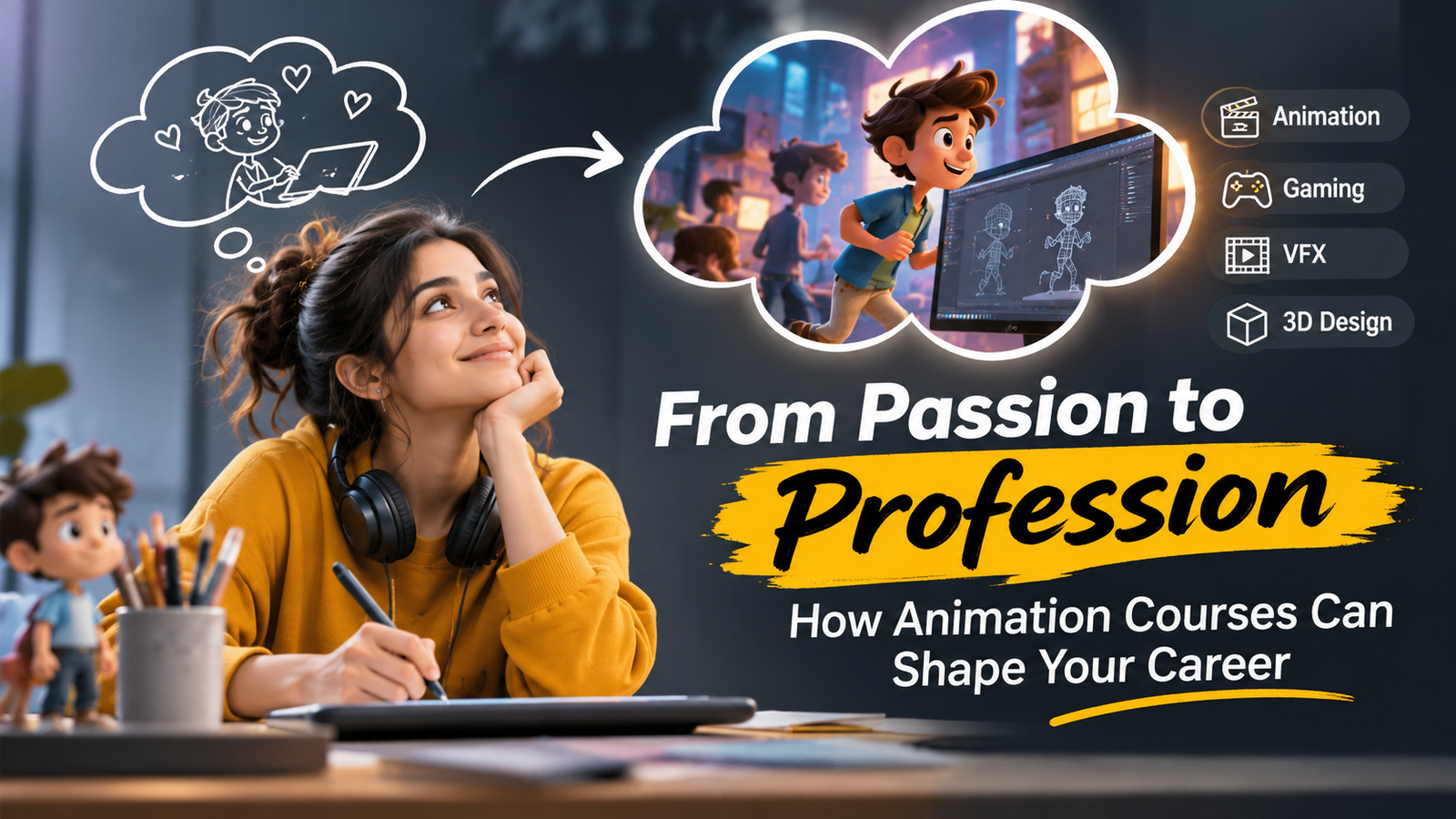
For students who enjoy drawing, storytelling, designing, or experimenting with digital creativity, animation can offer an exciting career direction. However, turning this passion into a profession requires more than creativity. It involves learning the right techniques, understanding industry tools, developing practical skills, and building a professional portfolio.
This is where professional animation courses can help students take their first steps towards a creative career.
1. Understand the Fundamentals of Animation
Every successful animation project begins with a strong understanding of the fundamentals. Before creating complex characters or impressive visual effects, students need to understand how animation works.
A structured animation course introduces learners to essential concepts such as:
- Principles of animation and character movement
- Drawing and visual composition
- Character design and development
- Storyboarding and visual storytelling
- Colour theory and perspective
- Timing, spacing, and motion
These fundamentals help students understand how to make animated objects and characters appear natural and expressive.
For example, creating a walking character involves understanding body movement, balance, timing, and facial expressions. Similarly, designing an animated environment requires knowledge of perspective, lighting, textures, and composition.
Learning these basics provides a strong foundation for exploring advanced animation techniques.
2. Develop Practical Skills with Industry-Relevant Software
Creativity is important, but technical knowledge also plays a significant role in animation careers. Modern animation professionals use specialised software to design characters, create movements, develop environments, and produce visual effects.
Depending on the course curriculum, students may get exposure to tools such as:
- Autodesk Maya: Used for 3D modelling, rigging, animation, and rendering.
- Blender: A popular tool for 3D modelling, animation, and visual creation.
- Adobe After Effects: Used for motion graphics and visual effects.
- Adobe Photoshop: Useful for digital illustration, concept art, and texture creation.
- Adobe Animate: Used for 2D animation and interactive content.
Learning these tools helps students understand the technical side of animation production.
However, simply knowing how to operate software is not enough. Students should also learn how to apply these tools creatively to complete projects, solve design challenges, and communicate visual ideas effectively.
3. Build a Professional Animation Portfolio
One of the most important aspects of starting a career in animation is developing a strong portfolio.
Unlike many traditional professions, creative industries often place significant importance on practical work. Employers and clients want to see what candidates can actually create.
A portfolio showcases your abilities, creative thinking, technical knowledge, and understanding of animation principles.
Students can gradually build their portfolios by working on projects such as:
- 2D character animation
- 3D character modelling
- Product animation
- Motion graphics
- Short animated videos
- Character expressions and movements
- Basic visual effects projects
Working on different projects also helps students discover their creative strengths and preferred specialisation.
A well-organised portfolio can make it easier to demonstrate your abilities during job applications, internships, freelance opportunities, and client presentations.
4. Explore Different Career Opportunities in Animation
The animation industry offers several career paths for individuals with different creative interests and technical abilities.
Here are some popular career options students can explore after developing relevant skills.
2D Animator
A 2D animator creates movement using two-dimensional characters, objects, and backgrounds. This role is commonly associated with animated videos, cartoons, advertisements, and educational content.
3D Animator
A 3D animator creates realistic or stylised movement using three-dimensional models. These professionals contribute to films, video games, advertisements, and digital productions.
Character Designer
Character designers develop the appearance, personality, expressions, and visual identity of animated characters.
3D Modeller
A 3D modeller creates digital objects, characters, products, and environments that can be used in animation, gaming, architecture, and visualisation projects.
Motion Graphics Artist
Motion graphics artists combine typography, graphics, shapes, and movement to create engaging visual content for advertisements, social media, presentations, and promotional videos.
Storyboard Artist
Storyboard artists convert written ideas and scripts into visual sequences. They help production teams understand how a story will progress before the animation process begins.
The right career path depends on your interests, technical abilities, creativity, and the specialisation you choose to pursue.
5. Understand the Role of Animation in Different Industries
Animation is no longer restricted to entertainment. Its applications have expanded across several industries, creating opportunities for skilled creative professionals.
Film and OTT Platforms: Animated films, visual effects, title sequences, and digital environments contribute to modern film and web series production.
Gaming Industry: Video games require character animation, environmental design, 3D modelling, and realistic movements to create engaging experiences.
Advertising and Marketing: Brands use animation and motion graphics to explain products, promote services, and create visually engaging campaigns.
Education and E-Learning: Animated videos make complex concepts easier to understand through illustrations, demonstrations, and visual explanations.
Architecture and Real Estate: 3D visualisation and animated walkthroughs help audiences understand building designs and interior spaces before construction.
This variety makes animation an interesting field for students who want to combine creativity with technology.
6. Why Choose Professional Animation Training?
Learning animation independently is possible, but structured professional training can provide a more organised learning experience.
A suitable animation course can help students:
- Learn concepts in a structured manner.
- Develop technical knowledge of animation tools.
- Receive guidance from experienced instructors.
- Work on practical assignments and creative projects.
- Understand different animation specialisations.
- Develop a portfolio to demonstrate their skills.
- Prepare for internships and potential employment opportunities.
Students should evaluate a course based on its curriculum, practical training opportunities, faculty experience, software exposure, and portfolio development support.
Choosing the right learning environment can make the journey from beginner to aspiring animation professional more focused.
7. How Digiquest Academy Can Help You Begin Your Creative Journey
At Digiquest Academy, students can explore creative learning opportunities in animation and related digital disciplines.
The objective of professional creative education is to help students develop both artistic understanding and technical capabilities. From learning the fundamentals to exploring digital tools and working on creative assignments, structured training can help learners understand the animation production process.
When considering an animation programme at Digiquest Academy, students should explore the available course curriculum, practical project opportunities, software training, faculty guidance, and career support.
Whether you are a beginner interested in animation or someone looking to develop existing creative skills, the right training can help you understand the possibilities within this industry.
Your journey does not need to begin with advanced technical knowledge. It can start with a simple interest in drawing, storytelling, characters, or digital creativity.
8. Start Turning Your Creative Passion into a Profession
A career in animation requires patience, continuous learning, experimentation, and a willingness to improve. The industry continues to evolve with new technologies, creative tools, and production techniques.
Students who focus on developing strong fundamentals, practising regularly, learning relevant software, and building impressive portfolios can prepare themselves to explore different opportunities in the creative industry.
Remember, every professional animator was once a beginner who had an idea and the motivation to bring it to life.
If animation is something you genuinely enjoy, consider exploring professional training and discovering where your creativity can take you.
Explore animation learning opportunities at Digiquest Academy and take your first step towards a creative future.
Frequently Asked Questions (FAQs)
1. Is animation a good career option for students?
Yes, animation can be an interesting career option for students who enjoy creativity, storytelling, digital design, and technology. Animation skills are used across films, gaming, advertising, education, digital media, and other creative industries.
2. Do I need drawing skills to learn animation?
Basic drawing skills can be helpful, especially for 2D animation and character design. However, not every animation specialisation requires advanced drawing abilities. Students can also explore 3D modelling, motion graphics, visual effects, and other technical areas.
3. What software is used in animation courses?
Animation programmes may introduce students to software such as Autodesk Maya, Blender, Adobe Photoshop, Adobe After Effects, and Adobe Animate. The specific tools depend on the course curriculum and specialisation.
4. What career opportunities are available after completing an animation course?
Students can explore opportunities as 2D animators, 3D animators, character designers, 3D modellers, storyboard artists, motion graphics artists, and visual effects artists. Career options depend on individual skills, portfolio quality, and industry requirements.
5. Can beginners join animation courses?
Yes, many animation programmes are designed for beginners. They introduce students to fundamental concepts before progressing towards advanced techniques and practical projects. Check the individual course’s eligibility requirements before enrolling.
6. How important is a portfolio for an animation career?
A portfolio is extremely important because it demonstrates your practical abilities, creativity, and technical understanding. It allows potential employers and clients to evaluate your work and understand your strengths.
7. What should I consider before choosing an animation institute?
Before selecting an institute, review its course curriculum, software training, practical assignments, faculty experience, portfolio development opportunities, infrastructure, and career guidance. Also, check whether the programme matches your preferred animation specialisation.
8. Can I work as a freelancer after learning animation?
Yes. Skilled animation professionals can explore freelance opportunities by creating animated videos, product visualisations, motion graphics, promotional content, and other digital projects. A strong portfolio and good communication skills can help attract clients.
9. Is animation limited to the film and television industry?
No. Animation is also used in gaming, digital marketing, advertising, education, architecture, real estate, social media, and corporate communication. This creates opportunities across different creative and technology-driven sectors.
10. Why should I consider learning animation at Digiquest Academy?
Digiquest Academy provides an opportunity for students to explore creative education and related digital disciplines. Before enrolling, students should review the available animation curriculum, practical learning opportunities, software exposure, and career guidance to find a programme aligned with their goals.